

Latest code changes indicate that the Snapdragon X-powered detachable Googlebook "Meru," currently under development by Google, is likely to be manufactured by ASUS rather than Lenovo.
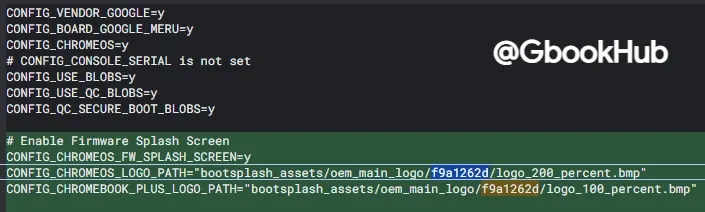
This stems from the OEM logo configuration loaded on Meru's boot screen, which specifies a unique folder name designating ASUS. This folder name is the same one used by the already-released "ASUS Googlebook 14," codenamed "Lapis."
Same OEM Logo Folder as Lapis
In a recently updated commit configuring Meru's OEM logo, the folder "f9a1262d" is specified, and these OEM logo folder names serve as identifiers assigned to each manufacturer.
Checking the current codebase reveals that the already-released ASUS Googlebook 14 ("Lapis") specifies the same "f9a1262d" folder, making it likely that Meru will also be made by ASUS.

When Meru first appeared, HP was considered a candidate because it was built on the design of HP's "Quartz." However, because the developer behind the commits was involved with devices such as Lenovo's Googlebook Duet 13 (Sapphire), it was previously thought to be a Lenovo model.
However, during early stages of development, work is often carried out across different manufacturers before a device is ultimately shifted to a different maker. With the addition of the more reliable OEM logo indicator this time, the earlier expectation has changed.
In addition, development is also underway on an unreleased board codenamed "Hekla," which uses the same logo folder name.
Detachable Form Factor and Expected Specs
Subsequently, code added to Meru indicated that it will feature a detachable form factor, along with support for a stylus capable of wireless charging.
This raised the possibility of a second tablet coming from Lenovo, though it remained uncertain given that Lenovo is already developing a high-end tablet and has begun work on several other models as well.
Specifications have not yet been confirmed either, but code for "Annite," "Pic," and "Aneto" (which entered development around the same time) indicates they may feature the Snapdragon X Plus, meaning Meru could similarly adopt the Snapdragon X Plus.
Based on development progress so far, Annite has been suggested to be a Dell model, Pic a Lenovo model, and Aneto an Acer model. If Meru is indeed from ASUS, all five manufacturers (ASUS, Acer, Lenovo, Dell, and HP) will have Googlebooks powered by Snapdragon.
At this point, neither the product names nor the release dates for Meru, Annite, Pic, and Aneto are known, but given the timing, they could arrive in the first half of 2027.