

Google is developing multiple Googlebooks powered by Intel Core Series 3 (Wildcat Lake), and I have confirmed that work is underway on a board called "Bianco."
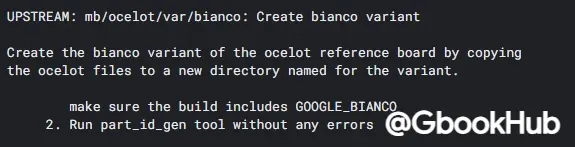
A commit spotted on Chromium Gerrit shows that "Bianco" was created by copying Ocelot, though the manufacturer and product name are not yet known at this point.
Copied from Ocelot with Initial Configuration Added
"Bianco" was created in September by copying Ocelot, and a subsequent commit reveals that it is expected to feature the following specifications. However, these may indicate the maximum specifications:
-
Ports: 2x USB-C (one on each side), 1x USB-A, 1x HDMI
-
Display: Supports HDMI output in addition to the built-in display (eDP), with optional touch support
-
Memory: LPDDR5x (onboard)
-
Storage: NVMe SSD (supports PCIe Gen4 / Gen5)
-
Audio: Realtek codec and speaker amplifier connected via SoundWire
-
Other: Optional fingerprint sensor and keyboard backlight
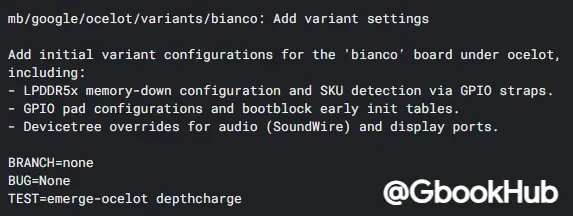
Because there is no mention of components such as an accelerometer to detect device orientation, it is likely to be a clamshell device rather than a 2-in-1 convertible.
Additionally, the developer who submitted the commit that created Bianco uses an email address with the "lcfc.corp-partner.google.com" domain, and since LCFC is responsible for developing and manufacturing Lenovo laptops, Bianco may be a Lenovo device.
11 Devices in Development in the Ocelot Family
With development on Bianco newly confirmed, there are now 11 development boards in the "Ocelot" family of Googlebooks powered by Intel Core Series 3 (Wildcat Lake):
-
Ojal (Unknown)
-
Matsu (Acer)
-
Kodkod (Unknown)
-
Ocicat (HP convertible)
-
Hekla (ASUS)
-
Coolum (HP clamshell)
-
Blanc (Lenovo clamshell)
-
Libra (Dell)
-
Pelion (Unknown)
-
Oncilla (Unknown)
-
Bianco (Lenovo clamshell)
Note that the manufacturers listed above are only projections based on the code, and since another board called "Blanc" that is also likely from Lenovo is in development, they could change during development.
That said, releases are already expected from the five companies that launched the first wave of Googlebooks, and since these models use the more affordable Intel Core Series 3 (Wildcat Lake) chips, it is entirely possible that the same manufacturer will release multiple models.
Future updates are expected to reveal more detailed specifications and the manufacturers.