

Between late July and early August 2026, three new mainboards—"Annite," "Pic," and "Meru"—were added to the "Bluey" family of Googlebooks powered by Qualcomm's Snapdragon X platform.
Among these, "Annite" and "Pic" were constructed by copying Dell’s "Mica" board and were initially expected to feature the higher-end Snapdragon X Elite. However, subsequent code analysis indicates they are more likely to be positioned as more affordable models equipped with the Snapdragon X Plus.
The 'Bluey' Platform Supports Two Distinct Processor Configurations
Initially, it was believed that the primary reference board for Snapdragon X-powered Googlebooks, "Bluey," would standardly adopt the Snapdragon X Plus across all devices. However, source code reveals the existence of two separate reference board configurations: "Bluey" and "BlueyH".

The code indicates that the base "Bluey" board is paired with the Snapdragon X Plus X1P-42-100, while "BlueyH" is configured with Hamoa, the development codename for the Snapdragon X Elite.

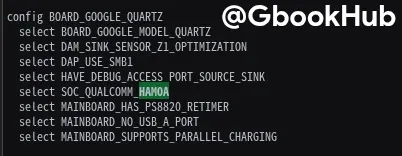
Recent Geekbench entries have already confirmed that the Bluey-based "Quartz" and "Mica" run on the Snapdragon X Elite X1E-80-100, which aligns with the Hamoa assignment in the codebase.
In the Coreboot source repository, both variants use "Bluey" as their mainboard foundation. However, explicit SoC selection flags demonstrate that not all devices in the family are locked to a single chip configuration.
'Annite' and 'Pic' Explicitly Reference the X1P-42-100 Chipset
While "Quartz" and "Mica" explicitly point to Hamoa (Snapdragon X Elite), recent code additions show that "Annite" and "Pic" specifically reference the X1P-42-100 (Snapdragon X Plus).
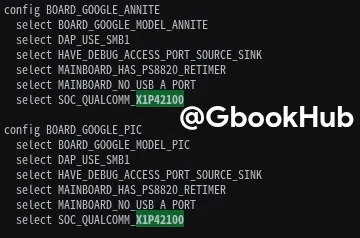
Furthermore, while "Annite" and "Pic" inherit their base code structure from "Mica," adjustments within the codebase show that the motherboard clock frequency has been reduced from 100 MHz to 75 MHz, confirming key differences in physical hardware specifications.
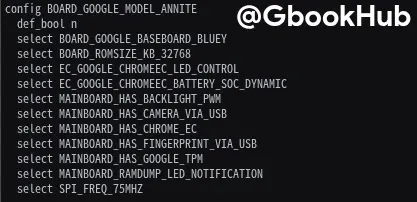
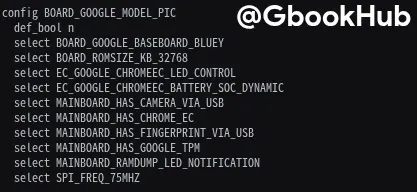
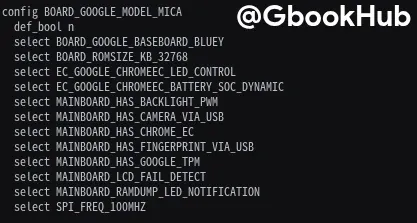
The codebase also indicates shared traits with Mica, such as the absence of a USB-A port and the inclusion of a fingerprint sensor.
Likely Positioned as Mid-Tier 'Mass Premium' Devices
Because "Annite" and "Pic" build upon the "Mica" architecture but substitute the Snapdragon X Elite for the lower-tier X Plus, they appear designed as cost-efficient models with slightly adjusted performance.
Prior details suggest that Googlebook devices running AL (Aluminium OS) will span three market categories: "AL Premium," "AL Mass Premium," and "AL Entry". The initial lineup scheduled for fall 2026 is expected to focus primarily on flagship "AL Premium" hardware.
While Google's initial push prioritizes high-end devices, the company’s broader strategy includes introducing more accessible price points over time. Given their current development status, "Annite" and "Pic" likely represent upcoming entries in the "Mass Premium" segment rather than the top-tier Premium class.
Detailed specifications for the "Meru" board remain unconfirmed, but its simultaneous appearance in the codebase suggests a similar mid-tier hardware profile.
Summary and Release Outlook
To summarize, while "Annite" and "Pic" inherit their core code structure from "Mica," they swap out the Snapdragon X Elite for the Snapdragon X Plus. This strongly points toward their role as mid-range "Mass Premium" Googlebooks.
An exact launch date has not been officially confirmed. Given that they are unlikely to be part of the initial wave in fall 2026, current development progress suggests a tentative debut around early 2027.
In the meantime, Google is already advancing development on next-generation devices powered by Qualcomm’s Snapdragon X2 (Calypso), which is slated to succeed the original Snapdragon X family in the flagship AL Premium segment.