

Following the first-generation Snapdragon X-powered "Bluey" series, development is already underway for a second generation of Googlebooks, codenamed "Calypso," featuring the new Snapdragon X2 architecture.
On the Chromium Gerrit, the name "Calypso" appears as both an SoC (System on a Chip) and a reference board. While initially spotted as a design based on the Snapdragon X Plus, subsequent code updates revealed a distinct SoC ID, confirming that Calypso actually belongs to the Snapdragon X2 generation.
Here is a comprehensive breakdown of the current development status of the Snapdragon X2-powered Calypso series.
"Calypso" is the Snapdragon X2 (Mahua)
quent device configuration update confirmed that Calypso was assigned a different ID (54) compared to the existing Snapdragon X Plus (SoC ID: 53), indicating it is an entirely separate chip.
While the code at that time suggested an X2 (second-generation) equivalent rather than the first-generation Snapdragon X, it was later revealed that Calypso is an alias for "Mahua," the 12-core die used in the Snapdragon X2 series.
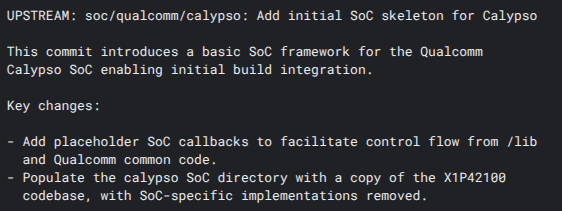
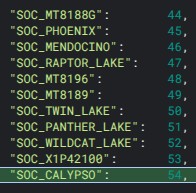
A UFS PHY initialization file reveals that Calypso and Mahua are treated synonymously. The fact that the same initialization table is used for both strongly supports that they refer to the exact same silicon.

Mahua is positioned just below "Glymur," the flagship 18-core die for the Snapdragon X2 Elite and X2 Elite Extreme. It is currently being deployed across configurations such as the Snapdragon X2 Plus (X2P-64-100) and Snapdragon X2 Elite (X2E-78-100, X2E-80-100, and X2E-84-100).
|
Product |
CPU Cores |
Max CPU Frequency |
CPU Cache |
GPU |
GPU Frequency |
NPU |
Supported Memory |
Memory Bandwidth |
|
X2E-84-100 |
12 |
Up to 4.7 GHz |
34 MB |
X2-85 |
Up to 1.70 GHz |
85 TOPS |
LPDDR5x |
Up to 152 GB/s |
|
X2E-80-100 |
12 |
Up to 4.7 GHz |
34 MB |
X2-85 |
Up to 1.70 GHz |
80 TOPS |
LPDDR5x |
Up to 152 GB/s |
|
X2E-78-100 |
12 |
Up to 4.0 GHz |
34 MB |
X2-85 |
Up to 1.35 GHz |
80 TOPS |
LPDDR5x |
Up to 152 GB/s |
|
X2P-64-100 |
10 |
Up to 4.0 GHz |
34 MB |
X2-45 |
1.7 GHz |
80 TOPS |
LPDDR5x |
Up to 152 GB/s |
|
X2P-42-100 |
6 |
Up to 4.0 GHz |
22 MB |
X2-45 |
0.91 GHz |
80 TOPS |
LPDDR5x |
Up to 152 GB/s |
This implies that Googlebooks built on the Calypso platform will be powered by chips equivalent to the Snapdragon X2 Plus or X2 Elite.
Boards Currently in Development
Originally, Calypso surfaced simply as the registered name for a new SoC, with "Mensa" assigned as its corresponding reference board. However, later updates restructured this so that Calypso now serves as both the SoC and the overarching project name, with Mensa categorized underneath it.
Reference Board: Mensa
Mensa is based on the design of its predecessor, Bluey, but has been specifically customized for the Calypso platform.
Information gathered so far points to a display resolution set at 1,920 × 1,080 (96 DPI). Additionally, code commits indicate support for SD card slots and USB-based recovery, strongly suggesting the inclusion of a microSD card reader.
Reference Board: c1nv
In June 2026, a second Calypso-derived board, codenamed "c1nv," was spotted in development. While detailed specifications remain unclear, code commits suggest support for configurations featuring up to a 16-inch display with a numeric keypad, OLED panels, convertible form factors, dual-fan cooling systems, ARGB LED lightbars, USB-C, and HDMI ports.
It is worth noting that the display sizes and numeric keypad details may simply define the maximum supported hardware limits, meaning actual retail products could vary in size and layout.
The Bottom Line
The revelation that "Calypso"—functioning as both the SoC and reference board moniker—belongs to the Snapdragon X2 generation confirms that Google is already deep into the development of its next-gen models, alongside the ongoing work on the first-generation "Bluey" series.
As a quick refresher, three models have already been identified within the first-generation "Bluey" lineup: the HP Googlebook 14c (Quartz), Dell XPS 13 (Mica), and Annite.