Coinciding with the Googlebook announcement, Google officially revealed the inclusion of an LED light bar named the "Glow Bar". This feature originates from the light bar equipped on the Chromebook Pixel released approximately 10 years ago. Regarding the revival of this long-absent feature at this specific time, a recent interview published by Chrome Unboxed with Google VP John Maletis details the background and future direction. Based on that interview, this article introduces the reasons why the Glow Bar was selected as a symbolic feature of the new Googlebook category.
The Origins of the Glow Bar: The Chromebook Pixel
The Glow Bar's prototype is the four-color LED light bar equipped on the Chromebook Pixel models released in 2013 and 2015. It offered a distinct sense of hardware playfulness; lightly tapping the closed lid displayed the remaining battery level, and specific command inputs triggered animated light sequences.
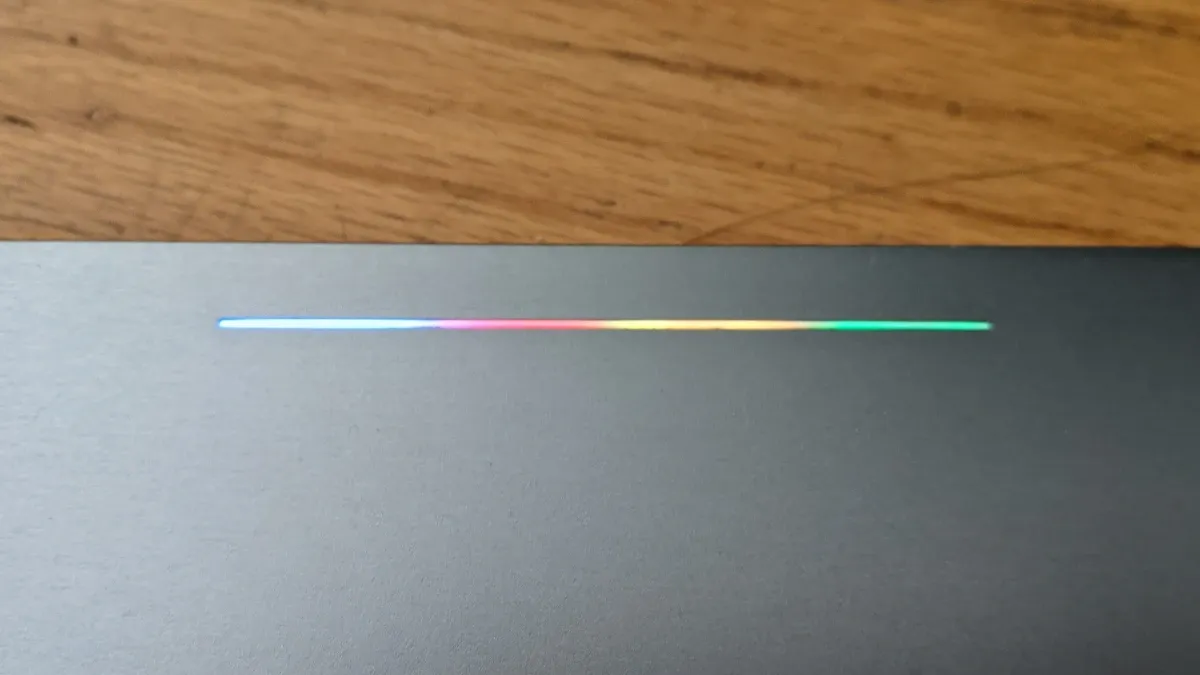
Maletis also reflected on this light bar in the interview, noting that it was a "very well-received and loved element".
Why It Disappeared for So Long
Following the Chromebook Pixel, this light bar vanished from Google laptops. Its inclusion was skipped on the Pixelbook introduced in 2017, as well as its successor models. According to Maletis, during this time, Google's internal UX team repeatedly voiced that they "should bring the light bar back". He explained that while its inclusion was considered at times, it ultimately did not materialize. (As a side note, although it was not adopted in Google's Chromebooks, a Lenovo Chromebook did adopt a similar light bar in 2021.)
Revival as the Symbol of the New Googlebook Category
The UX team's advocacy bore fruit right when Google positioned the Googlebook as an independent, new device category. Rather than serving as the quirk of an individual unit, the Glow Bar was incorporated into the common hardware requirements of all Googlebooks to act as a shared identification element for the entire category. Maletis emphasized that by providing such an easily understandable physical characteristic, users will be able to recognize a Googlebook at a glance in stores or on the street.
Direction: Light Effects Integrated with Workflows
Maletis stated, "I imagine a person working in a cafe with their Glow Bar lit up. It will be a hardware light effect that reflects the workflow the user is executing". This suggests that the Glow Bar will not be merely decorative, but a dynamic feature linked to activities on the OS. Because the Googlebook is designed as a category with Gemini Intelligence at its core, it is possible that the Glow Bar's illumination will indicate states such as Gemini's processing status or standby modes. While specific specifications—such as lighting patterns during background processing or notification methods—have not yet been revealed, it is expected to function as a part of the user interface rather than a simple decoration.
Wrapping Up
While the light bar's inclusion was shelved for many years, it has been revived as the Glow Bar approximately 10 years after the Chromebook Pixel, largely driven by the advocacy of Google's internal UX team. For this new iteration, the Glow Bar has been assigned the role of a category-wide identification element, serving as a baseline hardware requirement for the new Googlebook category. A clear direction has also been indicated for it to function as a light effect linked to OS workflows, setting expectations that it will go far beyond mere decoration.