

The Panther Lake-powered "Lapis," widely anticipated to be an ASUS Googlebook, has officially been spotted on Geekbench under the name "ASUS Lapis."
"Lapis" is one of the devices derived from the reference board "Fatcat," which features Panther Lake (Intel Core Series 3).
Confirmed Benchmark Scores
The benchmark listings on Geekbench under the moniker "ASUS Lapis" reveal two distinct configurations differing in their CPU and RAM. The average scores for each configuration are as follows:
| CPU / RAM Configuration | Average Single-Core | Average Multi-Core |
| Core Ultra 5 325 / 32GB | ~2,172 | ~8,789 |
| Core Ultra 7 355 / 64GB | ~2,481 | ~9,170 |
When comparing the Core Ultra 5 325 (Series 3) to the average scores of the Core Ultra 5 115U (Series 1) used in Chromebook Plus models, these results demonstrate roughly a 1.3x increase in single-core performance and a 1.6x boost in multi-core performance.
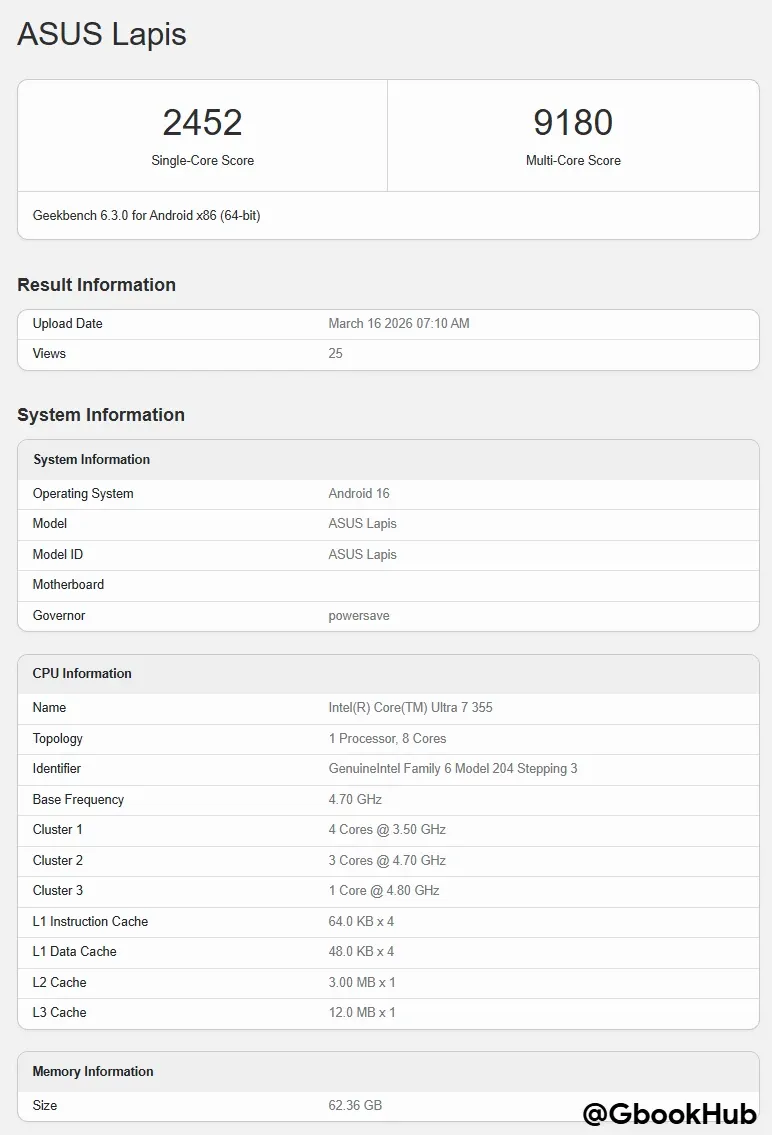
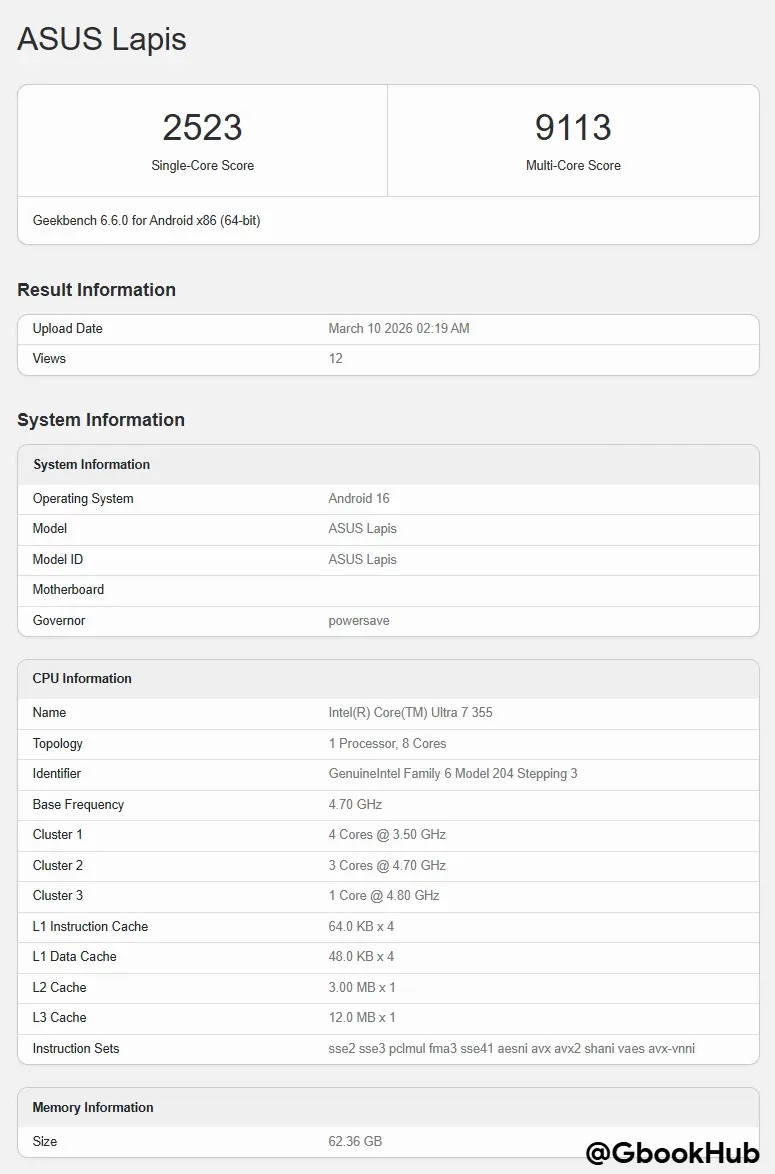
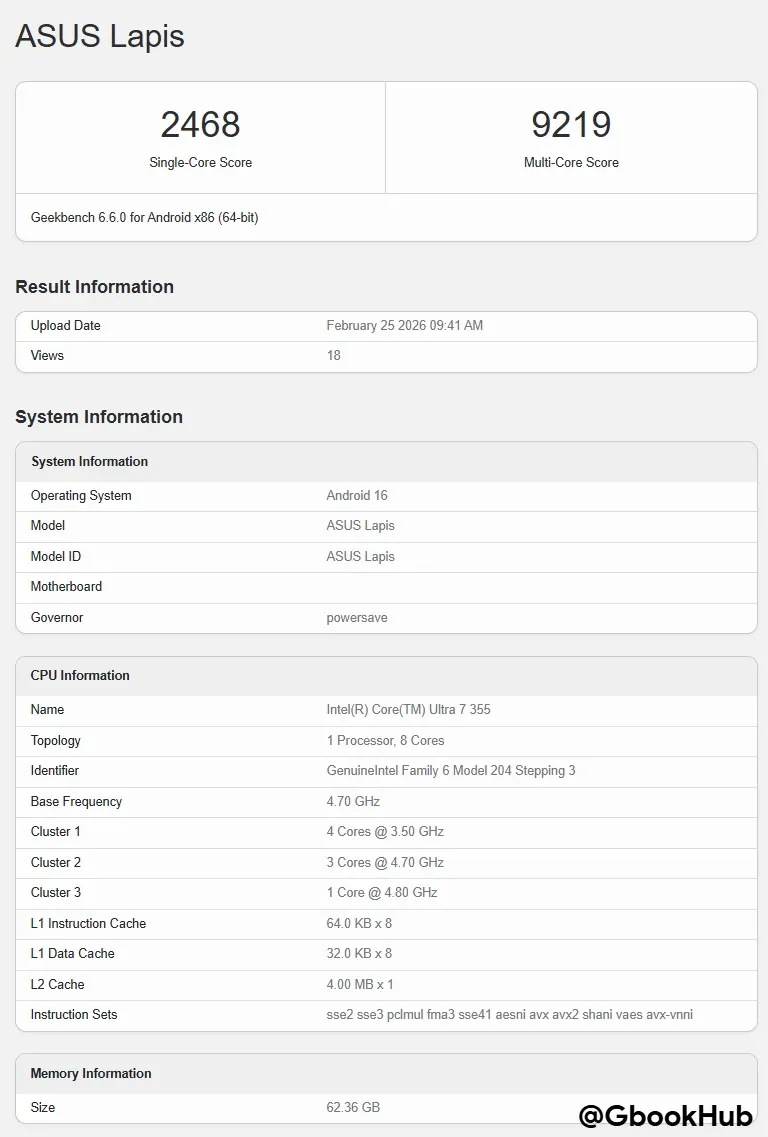
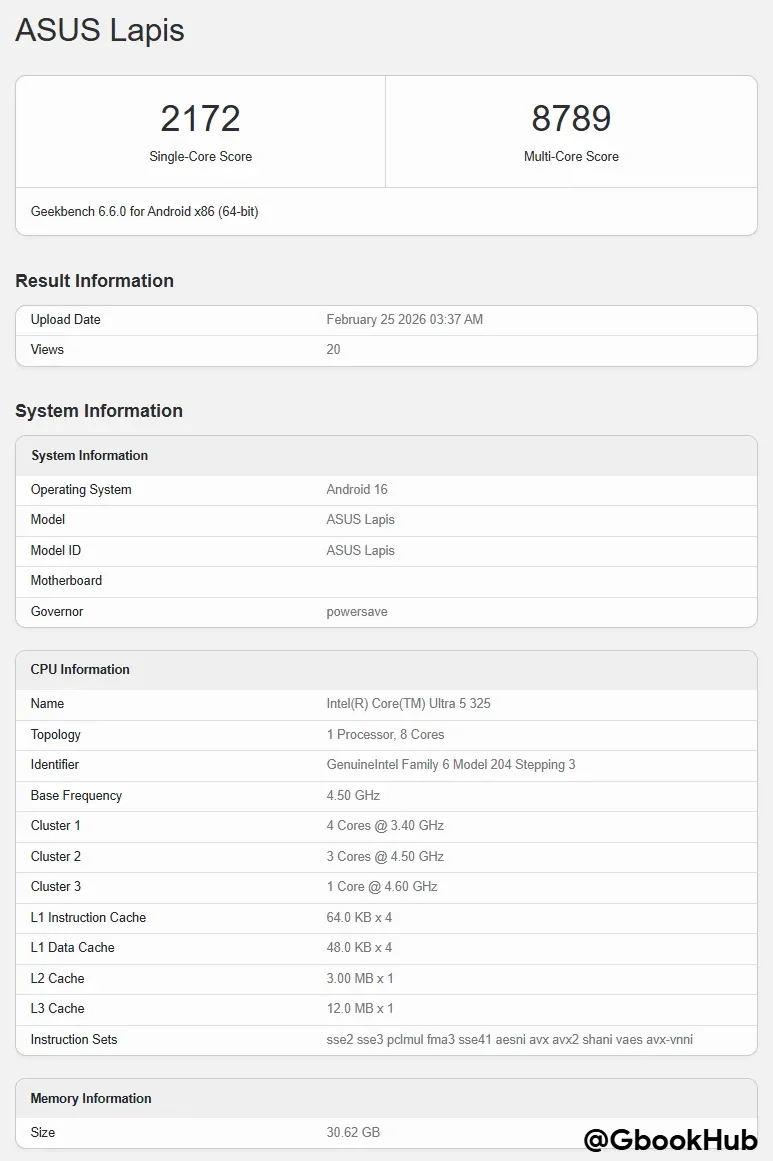
While the performance gap between the Core Ultra 5 and 7 is relatively narrow, the most significant highlight is that the Core Ultra 7 355 configuration is equipped with 64GB of RAM.
Previous Googlebook benchmarks we've tracked—including Fatcat, Ruby, Quartz, and Moonstone—have all featured either 16GB or 32GB of RAM. This makes a 64GB RAM configuration entirely unprecedented, even when factoring in past Chromebooks.
That being said, these benchmarks list the OS as Android 16, suggesting that this is likely an early-stage development prototype. It is important to note that these specifications may not necessarily reflect the final production model.
Summary
For context, similarly performing ASUS Windows laptops equipped with the Core Ultra 5 325 and 32GB of RAM are priced above 200,000 JPY. While some 16GB models fall below the 200,000 JPY mark, a system packing a Core Ultra 7 355 and 64GB of RAM would understandably command an even higher premium.
Whether Google will pack this level of hardware into their first-generation Googlebook remains to be seen. However, considering Google has referred to the first Googlebook as "super premium"—and given that these benchmarks exist, even as prototypes—it is entirely plausible that we could see such a high-end device hit the market.
via HelenTech