

"Felino," currently in development by Google, is one of the earliest devices to emerge from the "Fatcat" lineage—a pre-production reference board built around Intel's Panther Lake architecture.
When development initially kicked off, Felino was widely expected to arrive as a high-end Chromebook Plus. However, current consensus suggests it will debut as one of the very first devices released under the new "Googlebook" moniker.
Here is a comprehensive breakdown of everything we know so far about the development timeline and expected hardware of the Googlebook "Felino."
The Development Timeline
Felino is built on the foundation of the "Fatcat" reference board, which has been in the works since 2024. Evidence of Felino’s distinct development starting in December of that year marked its first confirmed appearance in the Chromium repository.
As development progressed, specific strings such as lges ap22a8n and smp ap23b7q were added to the battery-related code. These particular battery models have a proven track record in Acer devices, strongly hinting that Acer might be manufacturing Felino.
At the time, the device was anticipated to be a Chromebook Plus. Operating under the assumption that Acer was the manufacturer, Felino was viewed as a natural successor to their premium lineup, such as the Chromebook Plus 514, 515, or 714.
Shipping Manifest Specifications
Records from a shipping manifest published in September 2025 offered an early glimpse into Felino's potential hardware configuration:
-
Display: 16-inch
-
RAM: 32GB LPDDR5X
-
Storage: 1TB
-
Motherboard ID: Q7AP
Notably, the "Q7AP" motherboard ID corresponds to a top-tier PTL-H SKU within the Panther Lake family, packing a 16-core CPU (4P + 8E + 4LP-E) and 12 Xe3 GPU cores.
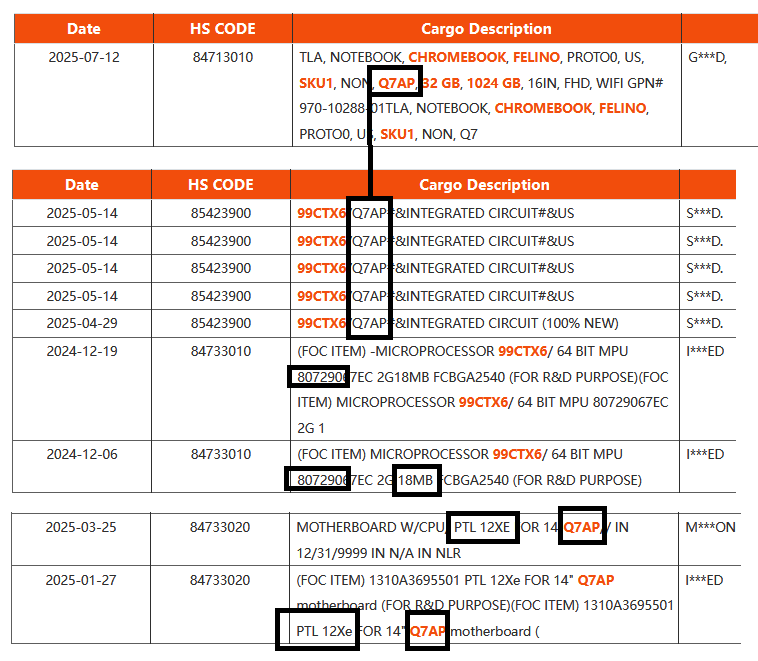
While this configuration set expectations for a hyper-premium model that vastly outpaces traditional Chromebooks, it is important to interpret this data with caution. Google often tests devices in active development with the maximum hardware specifications the board can support. Therefore, this manifest likely represents the ceiling of the hardware capabilities, rather than the baseline configuration hitting store shelves.
Anticipated Specifications
Based on the aforementioned shipping manifest and ongoing development commits, we can piece together a projected spec sheet for "Felino":
| Feature | Expected Specification |
| Display | 15.6 to 16-inch clamshell (Touchscreen optional) |
| Processor (CPU) | Intel PTL-U / PTL-H |
| Memory (RAM) | 16GB / 32GB LPDDR5X |
| Internal Storage | PCIe Gen 4 or Gen 5 NVMe SSD |
| External Storage | Potential SD / microSD card reader |
| Webcam | 1080p |
| Ports | 2x USB-C, 1x USB-A |
| Connectivity | Wi-Fi 7, Bluetooth |
| Extras | Dedicated numeric keypad (Numpad) |
While the development code initially pointed toward a model featuring a 15.6-inch or larger display with a numeric keypad, subsequent updates reveal that the architecture is also designed to scale down to 14-inch form factors.
Beyond the expected dual USB-C ports, numpad, 1080p webcam, and potential memory card reader, it is worth noting what is absent: there are currently no concrete references to a fingerprint sensor or a backlit keyboard in the source code.
Performance-wise, Geekbench benchmark scores have surfaced indicating a configuration with an estimated Intel Core Ultra 5 335 and 16GB of RAM. Regarding the higher-wattage PTL-H processor variant, the Fatcat development code includes an interesting caveat:
The initial version temporarily uses the PTL-H,but the thermal design is based on the PTL-U.Apply PTL-U's thermal settings here to avoid thermal issues.
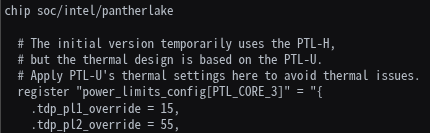
This suggests that while the PTL-H was utilized for initial engineering validation, the final retail units are highly likely to ship with the more thermally constrained PTL-U chips. Still, hardware configurations can vary significantly by SKU, so final retail specs remain a moving target.
Potential Manufacturer
As of this writing, there is no definitive code explicitly confirming which OEM will manufacture Felino.
However, the battery model numbers utilized in testing perfectly align with components heavily favored by Acer, making them the most probable candidate.
That being said, "Moonstone"—another device running on the Panther Lake architecture—has already been confirmed as an Acer product via its OS boot screen logo. Furthermore, there is evidence pointing to Acer for other boards like "Francka" and "Kinmen." Whether a single manufacturer would aggressively release this many distinct models during an initial launch wave remains debatable, leaving some room for speculation.
The Bottom Line
While the final specifications and the exact manufacturer of Felino are still somewhat shrouded in mystery, the core takeaway is clear: this device will feature premium, high-end hardware that significantly raises the bar for Google's laptop ecosystem.
Google has already teased a Fall 2026 release for its first wave of "ultra-premium" Googlebook models. Given that Felino has been in early development as a key pillar of the Fatcat series, it is highly anticipated to be part of this upcoming autumn hardware launch.
Source: HelenTech