

The highly anticipated Googlebook from ASUS, previously developed under the codename "Lapis," may officially hit the market as the ASUS Googlebook CX9406.
The "Lapis" device has been in development as part of the "Fatcat" series, powered by Intel's Panther Lake (Core Ultra Series 3) processors. Based on early development codes and benchmarks, it was already certain that this would be an ASUS device.
'CX9406CAA' Spotted in Certification Database
Recently, a new ASUS notebook carrying the model number "CX9406CAA" surfaced in the Energy Star certification database.
According to the certification listing, the device is configured with an Intel Core Ultra 7 processor, 64GB of RAM, and runs on Aluminium OS. Aluminium OS (ALOS) is a specialized Android-based operating system designed to integrate Android and ChromeOS for the new Googlebook lineup, confirming that this device is indeed a Googlebook.
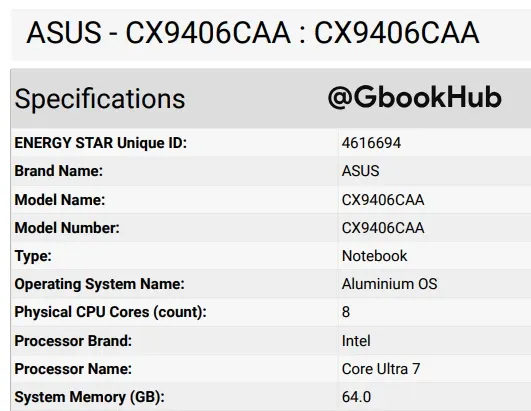
Furthermore, the combination of an Intel Core Ultra 7 and 64GB of RAM perfectly aligns with previous Geekbench benchmarks attributed to "ASUS Lapis." While the Energy Star certification does not specify the exact CPU model, if it mirrors the benchmark results, it is likely equipped with the Core Ultra 7 355.
Drawing Inspiration from the ExpertBook Ultra?
The "CX9" moniker within the "CX9406" model number is notable; it was previously utilized for the high-end ASUS Chromebook CX9 (CX9400). Currently, the "X9406" designation belongs to the Windows-based ASUS ExpertBook Ultra series. This suggests that the "Lapis" Googlebook could be positioned as a similarly premium, high-performance, and lightweight machine.
At this stage, details are limited to the "CX9406" model number and specifications projected from early benchmarks and development status. The finalized specs and the ultimate retail name remain unconfirmed.
Regardless, the emergence of a concrete model name for the ASUS Googlebook solidifies its position. It is now certain to be part of the first wave of Googlebook models launching in Fall 2026, standing alongside upcoming devices from Lenovo, Acer, and HP.