

On October 12, 2026, Google released the design specifications and upcoming development roadmap for the Linux terminal (preview) natively integrated into Googlebook. While the Linux terminal has been pre-installed as a preview since the launch of Googlebook, this announcement re-emphasized its current capabilities and expansion plans for AI workflows and software development.
Isolated Virtual Machines and AI Agent Integration
The Googlebook Linux terminal is designed as a development and execution environment for AI agents that perform package installations, file creation, and task automation directly from natural language prompts.
Adopting defense-in-depth as its core security principle, all terminal commands run within a Linux virtual machine (VM) sandbox isolated from the host OS. This separation prevents system corruption and unauthorized access to private personal files while granting sudo (administrator) privileges to command-line-heavy AI tools such as Antigravity.
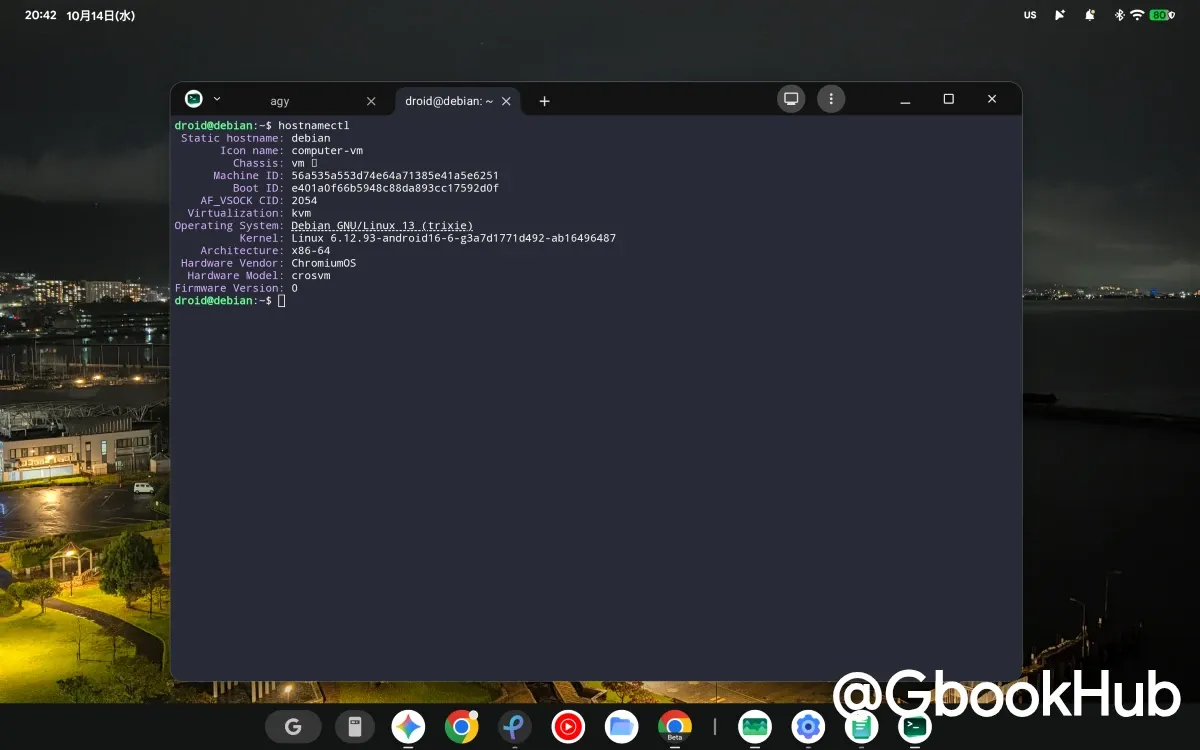
Directories on the host OS are mounted into the Linux VM only when explicitly authorized by the user. It also features a one-click VM reset function, allowing users to reinitialize the virtual environment while keeping files on the host file system intact.
Files within the Linux environment can be directly accessed via the Googlebook "Files" app, enabling batch processing via Python scripts or AI agents using photos synced from Android smartphones or local folder files.
Debian-Based Development Environment & Current Capabilities
The Googlebook Linux environment adopts Debian Linux, providing access to standard CLI tools such as apt, git, and ssh, alongside various compilers.
The current preview is optimized for CLI-based prototyping, web development, scripting, and AI agent workflows. It features automatic port forwarding of localhost to the host browser and supports runtimes including Node.js, Python, Ruby, Go, and Rust. Google engineers also utilize the Googlebook terminal environment for building the Linux kernel and platform engineering.
Future Roadmap and Feature Expansion Plans
While the initial launch did not support launching Linux GUI apps directly from the app launcher or running them in independent windows, the roadmap now includes GUI app support with direct app launcher integration. Additionally, the following expansions are planned:
-
USB Passthrough & USB-based ADB Support: In addition to existing network passthrough and wireless ADB, USB passthrough and USB-connected ADB will be supported, enabling debugging of external devices connected locally from the Linux VM or Antigravity.
-
Dynamic Memory and Storage Scaling: Capabilities to dynamically expand and adjust VM memory and storage capacity will be added to handle more complex tasks seamlessly.
-
GPU / NPU Hardware Acceleration: GPU and NPU acceleration features will be added to leverage dedicated hardware performance and power efficiency for demanding local workloads.
-
VM Persistence and Detaching Terminal Windows: To make it easier to maintain long-running processes—such as demanding AI agent workloads—VM persistence and separation from the terminal window will be implemented.
Specific timelines for the rollout of each feature have not been disclosed.